- News & Ads
-
 Feedback

First data release of the Burst Alert Telescope AGN legacy survey of molecular gas fueling in powerful nearby AGN
The APEX telescope has obtained CO(2-1) spectra for a sample of 165 hard-X-Ray-selected AGN galaxies detected in observations by the Burst Alert Telescope (BAT) onboard Swift. These observations, taken under the ESO programme id 198.A-0708, PI M. Koss, allow a statistical comparison of AGN and non-AGN dominated
galaxies in the local Universe, for example from the ALLSMOG APEX survey.
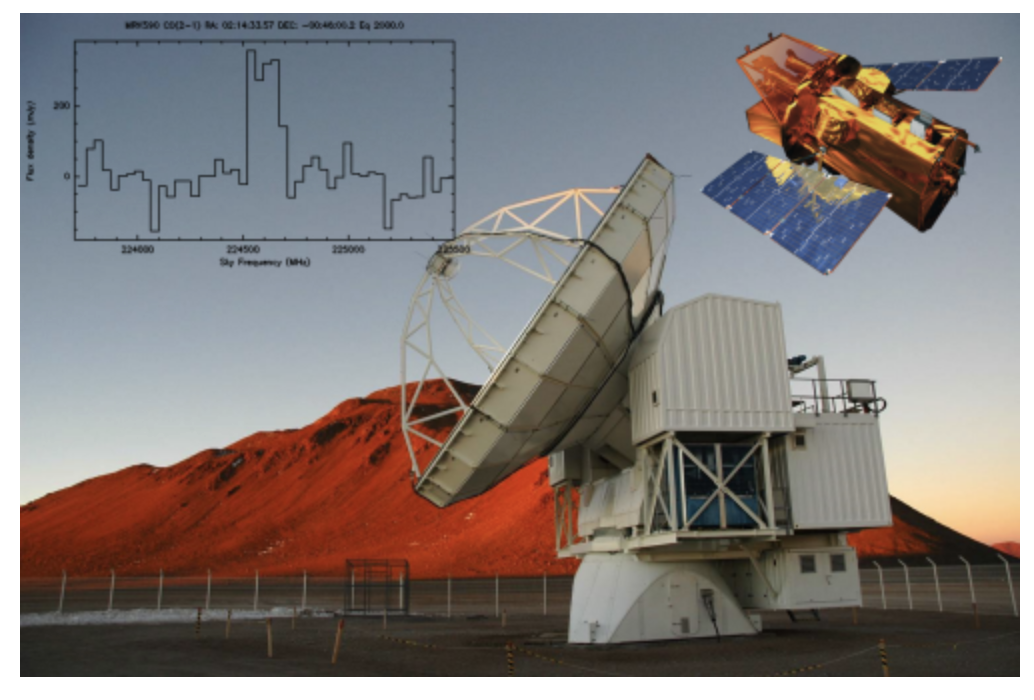
As this programme mainly aimed at observing a statistical sample of
nearby AGN, many of the galaxies observed are well-known galaxies, and these Phase 3 data can provide a valuable total power measurement of the CO(2-1) emission which then can be combined with interferometric observations obtained with ALMA.
Additionally, the BASS (BAT AGN Spectroscopic Survey) sample includes a variety of other ESO data products including hundreds of spectra with VLT/Xshooter, VLT/MUSE, and VLT/FORS2 with more information at the BASS survey website.
This BAT AGN release available via the Science Portal or programatically, makes the combined CO(2-1) spectra publicly available so users can derive further spectroscopic parameters, and compare them with other lines in these objects. The spectra either have a peak S/N>5 or reach depths of 0.5-2 mK rms for non-detections. Further details can be found in the data release paper or in the accompanying release description.
Instructions on how to read or display data in the ESO/SDP tabular data format can be found in the 1D spectrum data format help page.
Customer support service by UserEcho